
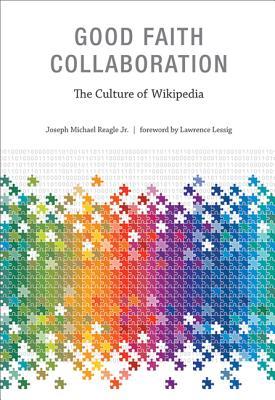
Good Faith Collaboration: The Culture of Wikipedia
By: Joseph Michael Reagle Jr.
Published August 27th 2010 by MIT Press
Category: Business
Pages: 244 pages
ISBN: 9780262014472
Description:
How Wikipedia collaboration addresses the challenges of openness, consensus, and leadership in a historical pursuit for a universal encyclopedia.
Wikipedia, the online encyclopedia, is built by a communityÑa community of Wikipedians who are expected to Òassume good faithÓ when interacting with one another. In Good Faith Collaboration, Joseph Reagle examines this unique collaborative culture.
Wikipedia, says Reagle, is not the first effort to create a freely shared, universal encyclopedia; its early twentieth-century ancestors include Paul Otlet's Universal Repository and H. G. Wells's proposal for a World Brain. Both these projects, like Wikipedia, were fuelled by new technologyÑwhich at the time included index cards and microfilm. What distinguishes Wikipedia from these and other more recent ventures is Wikipedia's good-faith collaborative culture, as seen not only in the writing and editing of articles but also in their discussion pages and edit histories. Keeping an open perspective on both knowledge claims and other contributors, Reagle argues, creates an extraordinary collaborative potential.
Wikipedia's style of collaborative production has been imitated, analyzed, and satirized. Despite the social unease over its implications for individual autonomy, institutional authority, and the character (and quality) of cultural products, Wikipedia's good-faith collaborative culture has brought us closer than ever to a realization of the century-old pursuit of a universal encyclopedia.


 Download all ebooks for free
 Call us! 1-800-413-6544